
Part 1: Basic Knowledge Questions
A mud pump is a positive-displacement reciprocating pump, the core equipment of solid control system for oil drilling, geological exploration and trenchless engineering.As the “heart” of a drilling fluid system, a mud pump operates through the coordinated functioning of two major sections: the power end and the fluid end.
The power end mainly consists of components such as the crankshaft, connecting rod, and crosshead, which convert the rotary motion of an electric motor or diesel engine into reciprocating linear motion. The fluid end uses pistons (or plungers) moving back and forth inside the liners to achieve the suction and discharge of drilling mud.
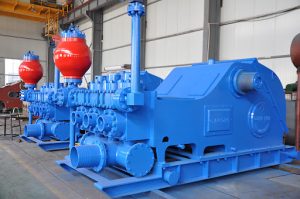
It has three primary functions: First, it circulates drilling mud under high pressure to carry cuttings from borehole bottom up to ground for separation. Second, the hydrostatic mud column balances formation pressure to prevent well collapse, kick or blowout. Third, high-pressure mud drives downhole positive displacement motors and hydraulic impactors to assist rock breaking during drilling.
Classified by cylinder quantity in industrial application:
Double-acting duplex mud pumps are outdated with heavy weight and severe pressure pulsation, rarely adopted in new drilling projects.
By working mode, pumps are divided into single-acting pump (suction & discharge on one side of piston) and double-acting pump (fluid flows through both piston sides).A triplex mud pump is equipped with three independent cylinders operating with phase offsets, allowing continuous mud delivery, reducing pressure fluctuations, and improving flow stability.
In practical drilling operations, a charge pump (boost pump) is usually installed upstream of the mud pump. Its purpose is to provide stable inlet pressure to the main pump, prevent cavitation, and improve volumetric efficiency. On drilling sites, it is also common for one charge pump to supply mud to two mud pumps. There are generally two methods to achieve this arrangement:
Method 1: Disconnect the charge pump motor from the SCR or VFD control system while retaining the original interlock logic, ensuring that the mud pumps can only start after the charge pump is running. This method requires minimal modification and can be implemented quickly. However, it may lead to issues such as uneven suction conditions and unstable flow distribution between the two mud pumps.
Method 2: Install new electrical connections from the mixing pump or mud supply system and comprehensively modify the control logic. After disconnecting the original control circuit, a new mud supply and interlock relationship is established. This approach is more systematic and can effectively ensure stable operation of both mud pumps. However, it involves more complex construction work and requires a higher level of technical expertise.
What key components does a mud pump consist of?
The whole pump is split into power end and fluid end:
– Power end: crankshaft, connecting rod, crosshead, gear set, bearings and pump housing, converting rotary power from engine or motor into reciprocating linear motion of pistons.
– Fluid end (wetted parts): liner, piston assembly, suction & discharge valve assembly and pump head, directly contacting drilling fluid to realize suction and pressurization.
Auxiliary accessories include safety relief valve, pulsation dampener, suction pipeline, high-pressure discharge line and centralized lubrication system.
Part 2: Selection & Parameter Questions
Model selection depends on three working conditions:
① Total drilling depth: Small-sized triplex pumps for shallow wells, heavy-duty high-pressure triplex pumps for kilometer-level oil & gas wells.
② Required flow rate and working pressure: Calculate target flow based on annulus volume and drill pipe inner diameter, confirm rated pressure against formation bearing capacity, reserve 15%~20% safety margin for pump rated parameters.
③ Drilling fluid property: Upgrade wear-resistant wetted part material for high-sand or corrosive mud; select compact lightweight pumps for truck-mounted rigs and heavy-duty large-flow pumps for fixed drilling platforms.
– Flow rate (displacement): Mud volume pumped per unit time, determines upward return velocity of drilling fluid. Insufficient flow fails to carry cuttings efficiently and causes stuck pipe from settled sand.
– Working pressure: Outlet pressure overcoming pipeline friction, borehole hydrostatic resistance and formation resistance; high pressure is required for deep well and high-pressure formation drilling.
Flow and pressure are negatively correlated: smaller liner size or lower stroke reduces flow while boosting working pressure, and vice versa.
Wetted components endure long-term erosion from sand-laden and acid-base mud with strict wear & corrosion resistance standards:
– Liner: high-chrome cast iron or bimetallic composite; ceramic lined liners for high-sand mud application.
– Piston: polyurethane coated with metal skeleton to resist abrasive cutting and tearing.
– Valve seat & valve core: stainless steel with hard alloy surfacing for anti-erosion and anti-cavitation performance.
Switch to stainless steel or wear-resistant alloy for all wetted parts under corrosive drilling fluid environment.
Part 3: Operation & Daily Use Questions
Dry running without mud is strictly prohibited.
Piston and liner rely on mud film for lubrication and cooling. Dry friction generates extreme high temperature within minutes, burning polyurethane piston and scrapping matched liner; valve components also deform from overheating without fluid cooling.
Part 4: Maintenance & Lubrication Questions
How to do regular maintenance for a mud pump?
– Daily maintenance: Clean mud residue around pump body, check leakage, oil level and connecting bolts per shift.
– Weekly maintenance: Inspect wear status of valve and piston, clean suction strainer.
– Monthly maintenance: Test clearance of crank bearing and crosshead, retighten foundation bolts.
– Overhaul after project completion: Disassemble power end and fluid end, replace aged seals and overworn spare parts.
What kind of lubricating oil should be used? How often to replace?
Oil replacement schedule: First oil change after 200 working hours for new pump; regular gear oil replacement every 1500~2000 working hours under normal service; replenish grease via grease nipples per shift as needed.
How to protect mud pumps when not in use for a long time?
Part 5: Troubleshooting & Fault Solutions
– Packing leakage at piston rod: Replace aged packing or add new sealing filler.
– Mud leakage between liner end face: Change damaged O-ring gasket of liner.
– Crack leakage on pump head body: Repair by welding or replace entire pump head.
Part 6: Spare Parts & Replacement Questions
Consumable parts for fluid end: piston assembly, liner, suction & discharge valve set, valve seat, O-rings and packing; power end wearing parts including oil seal and bearing replaced upon actual wear.

 English
  Russian
  Spanish
  Portuguese
  Arabic